Costly Conversations - The Hidden Impact of Answering the Phone


Picture your best performing team member. They're experienced, they know the business inside and out, and they're great with customers. Now imagine that for roughly 70% of their working day, they're spending time on the phone speaking with people they fundamentally can't help — answering routine questions, delivering the same polite declines, and starting again, from scratch, every few minutes.
That's not hypothetical. For many mid-sized businesses across the UK, this could be any weekday morning.
The good news? It doesn't need to be.
We recently worked with a specialist professional services company — a business that provides support to people who may struggle to access credit through mainstream banks. Their small team of underwriters were fielding around 1,000 inbound calls every month, alongside outbound client work and complex application processing.
The challenge wasn't just volume of calls. It was fit.
In their sector, only around 15% of all inbound customer enquiries result in a loan that can actually be approved. The remaining 85% — perfectly reasonable people making perfectly reasonable enquiries — simply didn't match the credit profile required. That's not a failure of anyone involved. It's just the nature of specialist financial services.
But here's what that actually looks like on a spreadsheet:
70% of inbound calls end with no qualifying outcome
That’s around 25,200 call minutes per year spent on unqualified enquiries (based on 700 calls per month averaging 3 minutes per call)
Based on industry averages for call handling* the estimated cost of answering those calls is somewhere in the region of £55,020
That's over fifty thousand pounds a year. Not being wasted due to inefficiency— just on conversations that, with the right kind of automation, would never reach a human underwriter in the first place.
"The problem isn't that the calls are happening. The problem is that the wrong people are spending time answering them."
The professional services example is a vivid one as the numbers are stark and it's also a scenario that is easy to imagine with from a consumer standpoint, where it's more helpful to be well informed before you speak with someone who might progress your loan application or similar. When it comes to customer service similar patterns play out across almost every sector where demand outpaces capacity - and where not every enquiry is the right fit.
Take a moment to recognise your business in one of these:
🏥Private Clinics & Healthcare
A busy aesthetics clinic or dental practice fields dozens of calls a day. Receptionists spend significant time explaining availability, pricing and suitability — often to callers who need a different service entirely. Every minute on the phone is a minute not spent supporting patients face to face.
⛳Golf Clubs, Leisure & Fitness
Golf clubs and leisure facilites receive a relentless mix of tee time enquiries, booking requests, green fee and membership queries. Many clubs have small front-of-house teams who spend hours answering questions that could be resolved instantly at any hour — by a well-configured voice assistant letting your team focus on member retention and in-person experience.
🏗️Construction, Facilities & Services
Whether it's a regional builder, a facilities management company or a specialist contractor, inbound enquiries span emergency callouts, quote requests and compliance questions. Project managers are often the first port of call — when their time is far more valuable on site or in specification reviews.
🏨Hotels & Hospitality
Front desk teams at boutique hotels and event venues handle an enormous range of calls — from availability, ticketing enquiries, hospitality queries to dietary requirements and directions. An intelligent AI Reception Assistant triage can answer the routine, freeing your team to focus on delivering more in-person attention that defines genuine hospitality.
🏛️Public Sector & Local Services
Councils, housing associations and public bodies face high inbound volumes with stretched teams. Many callers need signposting rather than case management — and AI voice assistance can handle initial triage, provide information and log contact details before any human involvement is required.
For the professional services client, we proposed a two-phase solution that addressed the problem at both entry points — the phone and the website.
An AI Receptionist is a voice-enabled assistant that is trained on the company's own business data to answer inbound calls, engage callers naturally, and route enquiries intelligently. For this client, that means a caller who doesn't meet the initial credit criteria is handled gracefully and efficiently — without ever reaching an underwriter's desk. No hold music. No frustration. No wasted time on either side.
As it's also available 24 hours a day, seven days a week, the AI Receptionist also captures out-of-hours enquiries that would otherwise go unanswered — meaning more of the right leads get picked up and progressed.
The Nano Knowledge Assistant works differently: it gives your website a natural, conversational voice interface. Visitors simply speak their question — no app, no phone call, no contact form to complete. They get an instant, accurate answer - and if they're a good fit, they're guided naturally towards an enquiry or application.
For the lending business, this means potential applicants can check their eligibility, understand the product and decide whether to proceed — all before even picking up the phone. The calls that do come in are better qualified from the outset - and Nano even schedules meetings for the loan underwriters when a customer meets the criteria.
Together, these two tools create a triage layer that didn't previously exist: a front door that identifies, informs and routes — so the team behind it can spend more time on qualified opportunities.
We generally suggest modeling ROI in three-year terms, because that's where the true operational picture becomes clear. Based on the client's current cost base of £55,020 per year — or £165,060 over three years — the scenarios look something like this:
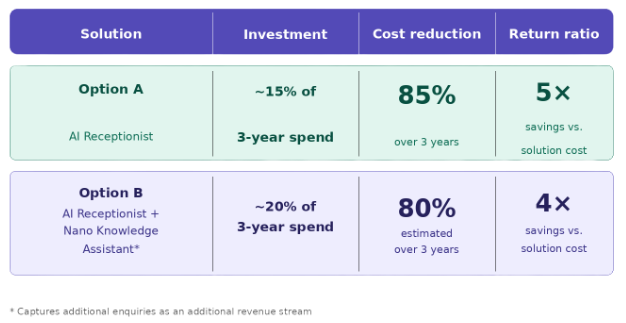
Our professional services client wasn't surprised that the cost of managing inbound enquiries was eating into margin - but seeing the numbers laid out clearly brought the scale of the opportunity into sharp focus. In this example Option A, the AI Receptionist alone, requires an investment of around £24,750 over three years and delivers an estimated 85% cost reduction, returning more than five times the solution cost in savings. Option B adds the Nano Knowledge Assistant, nudging the investment to approximately £33,000 while still delivering an estimated 80% cost reduction - and crucially, turning what were previously missed out-of-hours enquiries into a genuine additional revenue stream.
One thing we've learned from deploying AI automation across very different organisations — from housing associations to hotel groups — is that the biggest risk isn't doing too little. It's trying to deliver too much, too fast.
We advocate a phased approach: start with a tightly defined, high-impact use case - Prove the value. Then expand. For most businesses, that means beginning with inbound call triage — the single most consistent source of avoidable cost — and adding automation to additional channels, including messaging or voice once the first layer is delivering results and you're customers are used to the new service.
This approach keeps implementation risk low, delivers early wins that build internal confidence, and creates a foundation that can grow with the business over time.
If you manage a team or business that handles inbound enquiries, it's worth asking yourself what proportion of the calls they take today will actually lead to business?
For most organisations, the answer is lower than half. For some, like our finance client - it's well below 20%.
That's not a reflection on the team. It's a structural challenge that technology is now genuinely equipped to solve. The question isn't whether an AI Assistant can handle routine enquiries — it demonstrably can. The question is how much longer it makes sense to let your most experienced people do it instead.
We'll model the operational cost of your current inbound process and show you exactly where AI automation can make a measurable difference.
*Contact Centre Leaders Decision Making Guide, 2025